
U.S. Triples Uranium Output to 2.1M Lbs: 1,824 Drill Holes & 1M+ Feet
U.S. yellowcake output hit 2.1 million pounds in 2025, but foreign imports still fuel over 90% of the nation's nuclear grid.
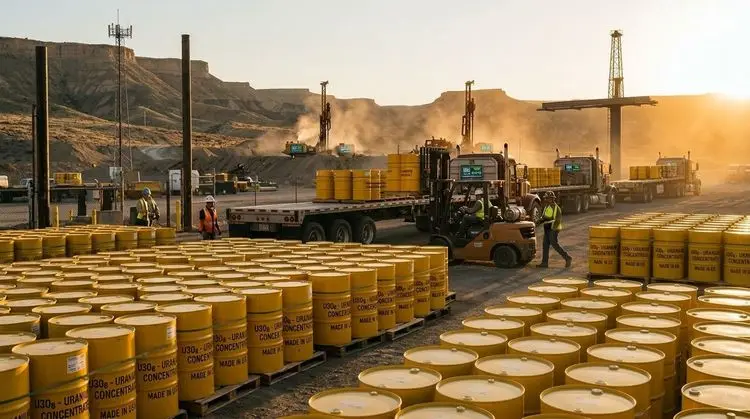
America’s nuclear engine is revving up again, and domestic uranium miners are officially back in the sandbox.
Newly released numbers from the U.S. Energy Information Administration reveal that domestic uranium concentrate production hit 2.1 million pounds of triuranium octoxide (U3O8) in 2025.
That volume marks a threefold surge over 2024 levels and the highest annual output recorded since 2017. Yet while the rebound is impressive on paper, it highlights a persistent reality for power grid strategists: the U.S. is still relying heavily on foreign imports to keep its reactors running.
The operational hustle behind this yellowcake rally is visible right in the dirt.
Exploration drillers carved out 1,824 holes totaling more than 1.0 million feet in 2025, up sharply from 1,324 holes and 0.6 million feet in 2024.
Development drilling aimed at measuring known underground deposits rose to 3,708 holes across 1.30 million feet, surpassing the previous year’s 2,462 holes and 1.26 million feet. Mining crews are actively laying the groundwork for a multi-year revival.
Industry leadership views this drill-heavy momentum as the opening chapter of a much larger supercycle. Mark Chalmers, CEO of Energy Fuels Inc. (NYSE American: UUUU), characterized the period as a breakout phase where operational ramp-ups set the stage for significant long-term cash generation as pricing firms up. Expressing similar optimism, Amir Adnani, CEO of Uranium Energy Corp (NYSE American: UEC), emphasized that recent operational gains represent a structural step change designed to match policy support and looming market supply deficits.
Despite domestic progress, utility buying habits demonstrate how dependent the country remains on global trade routes. U.S. nuclear plant owners purchased 46.9 million pounds of U3O8 equivalent in 2025, down from 55.9 million pounds in 2024, at a weighted-average price of $58.46 per pound, marking an 11% increase over the 2024 price of $52.71 per pound. Foreign suppliers provided 43.5 million pounds of that total. Canadian mines led the pack by supplying 32% of total deliveries, followed by Kazakhstan at 28% and Australia at 15%. Domestic U.S.-origin material accounted for just 7% of delivered reactor fuel.
That persistent supply gap explains why miners are eager to keep pushing. Scott Melbye, Executive Vice President of Uranium Energy Corp (NYSE American: UEC) and President of the Uranium Producers of America, highlighted that near-term global supply shortages, combined with rising AI data center power needs and federal curbs on Russian nuclear imports, are forcing Western utilities back into long-term contracting.
Domestic miners are racing to ensure America can actually fuel its own clean energy grid.
Sources
- Data provided by the U.S. Energy Information Administration (Monthly Energy Review, Domestic Uranium Production Report, and Uranium Marketing Annual Report) published August 28, 2026. Executive statements and operational commentary sourced from public corporate earnings updates and industry analysis by Energy Fuels Inc. (NYSE American: UUUU) and Uranium Energy Corp (NYSE American: UEC).
Disclaimer
Neither the author of this article nor JuniorStocks.com holds equity, stock options, or any other financial positions in Energy Fuels Inc. (NYSE American: UUUU), Uranium Energy Corp (NYSE American: UEC), or any other companies mentioned in this publication. This content is published by JuniorStocks.com strictly for informational purposes, was prepared independently without company compensation, and utilized AI assistance for text editing, formatting, and generating accompanying media. While U.S. uranium production and the nuclear energy sector represent a compelling frontier in clean energy, this article does not constitute investment or financial advice. Investors are strongly advised to conduct their own thorough, independent due diligence and consult with a qualified financial professional before making any investment decisions.