SPONSORED

The Six-Week Warning: How the Strait of Hormuz Blockade is Grounding Global Markets

As Europe stares down a six-week runway for aviation fuel, soaring crude prices threaten to trigger a wave of global stagflation, paralyze supply chains, and starve junior markets of capital.
•• 1 Min
The Six-Week Warning: How the Strait of Hormuz Blockade is Grounding Global Markets

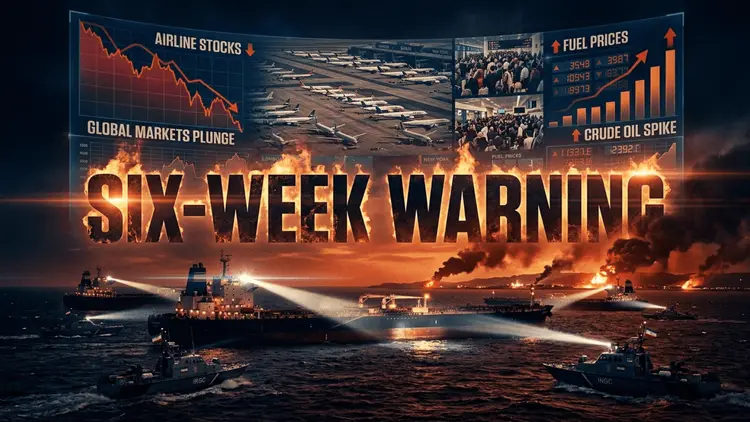
Buckle up, investors, because the geopolitical turbulence is officially spilling from the tarmac straight onto the trading floor. International Energy Agency Executive Director Fatih Birol dropped a bombshell on the global economy this week, warning that Europe is staring down the barrel of a mere six-week supply of jet fuel. The culprit is the unprecedented blockade of the Strait of Hormuz, an arterial waterway that normally handles a massive chunk of the world's energy trade. While grounded flights and ruined holidays grab the mainstream headlines, the underlying mechanics of this supply shock are quietly tearing through the global financial ecosystem.

When an energy watchdog characterizes a situation as the largest energy crisis we have ever faced, Wall Street takes immediate notice. The primary threat to equity markets is the terrifying resurgence of stagflation. As crude and refined product prices skyrocket, consumer purchasing power is effectively incinerated. Central banks find themselves boxed into a corner; they cannot easily slash interest rates to stimulate economic growth when energy-driven inflation is roaring back. This dynamic triggers a violent rotation out of risk assets and growth stocks, sending capital fleeing toward defensive safe havens. Airlines like Ryanair Holdings plc (Nasdaq: RYAAY) and Air France-KLM S.A. (Euronext Paris: AF) are already making painful schedule adjustments as the sheer cost of kerosene outpaces passenger revenue, but the market contagion runs much deeper than aviation. Broad market indices absorb the blow as profit margins across virtually every sector get squeezed by surging operational costs.

The disruption certainly does not stop at the boarding gate. The Strait of Hormuz is not just an oil pipeline; it is a fundamental chokepoint for global commodities, including liquefied natural gas and essential petrochemicals. When these vital shipments are trapped, the entire global supply chain begins to seize up. Freight and shipping insurance premiums explode, forcing logistics giants like A.P. Møller - Mærsk A/S (Nasdaq Copenhagen: MAERSK-B) and maritime analytics firms like Vortexa to navigate logistical nightmares and soaring operational expenses. This friction translates into staggering input costs for manufacturers and retailers worldwide. From the plastic packaging on fast-moving consumer goods to the fertilizers needed for global agriculture, every single link in the chain becomes drastically more expensive to maintain.

If the broader market is catching a cold from this energy shock, the highly speculative junior markets are coming down with a severe case of pneumonia. Junior mining and exploration companies are incredibly vulnerable to energy volatility. These operations are heavily reliant on diesel to power their remote drills, heavy machinery, and transport fleets. A sustained spike in oil prices violently inflates their All-In Sustaining Costs, bleeding their already limited capital pools dry. Unlike major diversified producers such as Chevron Corporation (NYSE: CVX), these juniors rarely possess active revenue streams to offset the pain; they survive entirely by raising equity. However, in a risk-off stock market environment, the investor appetite for funding high-risk exploration simply vanishes. This capital starvation forces development delays and sector-wide consolidation, leaving only the most well-capitalized juniors standing.

Ultimately, the six-week jet fuel countdown is merely the canary in the coal mine for a much broader macroeconomic reckoning. Until diplomatic or military breakthroughs reopen the Strait of Hormuz, investors and supply chain managers alike will have to navigate a profoundly volatile landscape.

Source:

  • Associated Press (AP) interview with IEA Executive Director Fatih Birol, April 16, 2026.

Most Popular News

  1. SpaceX’s $8B Spectrum Deal Sends AT&T, Verizon, and T-Mobile Plummeting
  2. Is Project Vault Securing America’s Supply Chain or Squeezing It to the Breaking Point?
  3. Why Gautam Lohia Shifted from Global Consulting to Reboot a $20M Tech Micro-Cap
  4. Everyday Luxury, Unstoppable Scale: Aritzia Delivers 44% Net Revenue Growth
  5. Can Navy SEAL Leadership and Big Tech Scale Revolutionize Airborne Threat Detection?

Disclaimer


This report should not be viewed as investment advice or as an offer to buy or sell any securities or as an invitation or solicitation of an offer to buy or sell any securities. Neither the author of this report, its publisher, nor any other person associated with the publication of this report, are registered brokers, investment dealers, investment advisers, or financial advisers. The information in this report has not been tailored to the particular needs or circumstances of readers and should not be relied upon as investment advice or recommendations to purchase or sell any of the securities presented in this report. Readers seeking investment advice should contact qualified and registered brokers, investment dealers, investment advisers, or financial advisers prior to making any decision to buy or sell any of the securities referred to in this report. The information in this report should not be construed as investment, legal, or tax advice. No recommendation is made as to whether an investment in the presented securities is suitable for any reader in light of the reader’s particular circumstances.

Readers are cautioned that the publisher of this report covers exclusively securities that carry a high degree of volatility. Investing in such securities is highly speculative and carries a high degree of risk. Investors in such securities could lose all or a substantial portion of their investment. Only those investors who can afford to lose all or a substantial portion of their investment should consider investing in the securities referred to in this report.

This report may include information obtained from publicly available sources, including third-party reports or analysis. Neither the author nor publisher of this report, nor www.juniorstocks.com or its owners, have undertaken any independent investigation into the factual information used in this report, and the information in this report is provided without any warranty of any kind. No representations or warranties are provided regarding the accuracy or completeness of the information provided in this report. Statements of opinion or belief are those of the authors and/or publisher of this report. These statements of opinion or belief are expressions of the author’s and/or publisher’s judgment, and there is no guarantee that those judgments will turn out to be correct. No inference should be drawn that the author and/or publisher have any special or greater knowledge about the presented companies or their securities, or any particular expertise in the industries or markets in which the company operates. Readers should conduct their own due diligence and seek professional advice prior to investing in any securities presented on Juniorstocks.com.

Certain statements in this report constitute “forward-looking” statements. Forward-looking statements often, but not always, are identified by the use of words such as “seek,” “anticipate,” “believe,” “plan,” “estimate,” “expect,” “targeting,” and “intend” and statements that an event or result “may,” “will,” “should,” “could,” or “might” occur or be achieved and other similar expressions. Forward-looking statements express or involve discussions with respect to predictions, expectations, beliefs, plans, projections, objectives, goals, assumptions, or future events or performance; they are not statements of historical facts and should not be viewed as any guarantee of any future result. Forward-looking statements are based on expectations, estimates, and projections at the time the statements are made that involve a number of risks and uncertainties which could cause actual results or events to differ materially from those presently anticipated. The author and/or publisher of this report disclaims any obligation to update the forward-looking statements in this report, whether as a result of new information, future events, or results or otherwise. There is no assurance that forward-looking statements will prove to be accurate, as actual results and future events could differ materially from those anticipated in such statements. Accordingly, readers should not place undue reliance on forward-looking statements.

The information provided in this report is not intended for distribution to, or use by, any person or entity in any jurisdiction or country where such distribution or use would be contrary to applicable law or regulation, or would subject the author or publisher of this report to any registration requirement in such jurisdiction or country.

Information about the editor of this publication:
Juniorstocks.com is a service provided by Piccadilly Capital Group, Office 66, 101 Clapham High Street, London, SW4 7TB, UK. Piccadilly Capital Group is not the publisher of this report and was not paid for the publication of this report. Piccadilly Capital Group seeks to generate web traffic and a growing number of followers through the publication of articles or reports. Directors, officers, and other insiders of the publisher own an interest in Piccadilly Capital Group. Piccadilly Capital Group does not endorse or recommend the business, products, services, or securities of any company mentioned on www.juniorstocks.com. Piccadilly Capital Group will not share your information with any outside third parties. Due to the new data protection basic regulation, we ask you to read our data protection declaration carefully.

Note on copyright:
The contents published on this website and on connected media (e.g., e-mail, X, Facebook) are subject to applicable copyright and ancillary copyright laws. Any use not permitted by applicable copyright and ancillary copyright laws requires the prior written consent of the provider or the respective rights holder. In particular, this applies to the duplication, editing, translation, storage, processing, or reproduction of content in databases or other electronic media and systems. Contents and rights of third parties are marked as such. Unauthorized reproduction or transmission of individual contents or complete pages is not permitted and is punishable by law. Only the production of copies and downloads for personal, private, and non-commercial use is permitted. Links to the provider's website are always welcome and do not require the consent of the provider of the website. Photos and images on the website may not be shared unless the publisher itself has acquired the initial rights from authorized sources. The presentation of this website in external frames is only allowed with written permission. If you notice any violations, please inform us. Please note: The content of our articles, emails, or other publications or social networks such as X, LinkedIn or Facebook is exclusively intended for the designated addressee(s). If you are not the addressee of these articles, emails, or other publications in the market letter or social networks such as Twitter or Facebook or his or her legal representative, please note that any form of publication, reproduction, or distribution of the content of these articles, emails, or other publications in the market letter or social networks such as X, LinkedIn or Facebook is prohibited. Falsifications of the original content of this message during data transmission cannot be excluded in principle.