
The Science Behind Kalo Gold’s Latest Exploration Breakthrough in Fiji
How microscopic electrum inside drill hole VA26-DH19 is vectoring exploration teams toward Fiji's next potential gold discovery at Vatu Aurum.
Here at JuniorStocks.com, we have had our eye on the Fijian mineral exploration story, and specifically Kalo Gold Corp. (TSXV: KALO / OTCID: KLGDF), for quite some time, tracking how their systematic technical program on Vanua Levu would evolve.
Unlocking high-grade potential in the South Pacific takes equal parts field persistence and microscopic precision, and the company just delivered a major mineralogical milestone at its flagship Vatu Aurum Project. By confirming the presence of fine-grained electrum deep within drill core at the Wainikoro target using advanced scanning electron microscopy, the team has locked down direct, visual evidence of the physical gold and silver powering this epithermal hydrothermal system.
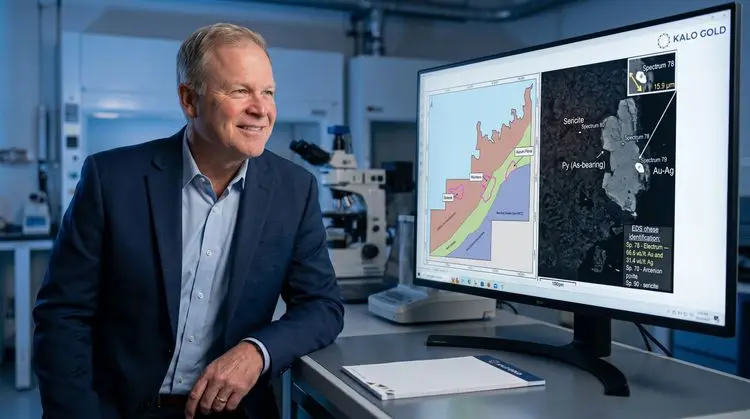
The milestone comes directly out of an academic-industry research partnership led by Heidi Walton at the Camborne School of Mines, University of Exeter, supported directly by Kalo Gold. Examining drill core from hole VA26-DH19 at a downhole depth between 189.88 and 191.00 meters, high-resolution SEM-EDS analysis identified a discrete electrum grain measuring roughly 20 micrometers across. Energy-dispersive spectroscopy measured its composition at approximately 68.6 weight percent gold and 31.4 weight percent silver. Sitting directly along the margin of an arsenian pyrite grain inside a sericite-bearing matrix, the electrum occurs within a chlorite-altered polymictic volcanic breccia cut by quartz-carbonate veinlets and disseminated trace sulfides.
While a single 20-micrometer grain might sound minute to casual market observers, to economic geologists it serves as a structural smoking gun. The micro-texture proves that gold at Wainikoro occurs locally as a distinct gold-silver alloy bound within a repeatedly fractured, brecciated volcanic host rock. These mineralogical signatures document multiple episodes of brittle shattering, fluid circulation, and sulfide deposition. This ties neatly back into earlier drilling in hole VA26-DH19, which intersected a gold interval returning 1.61 grams per tonne gold over 1.50 meters near the 150-meter mark, confirming that mineralizing hydrothermal fluids moved through multiple structurally prepared corridors downhole.
Multivariate geochemical mapping across the drill core highlighted a broad hydrothermal signature consisting of gold, silver, arsenic, antimony, lead, and molybdenum. Statistical analysis showed that gold couples most strongly with lead, silver, and molybdenum, whereas elevated arsenic and antimony map the broader outer footprint of the hydrothermal engine. Because arsenian pyrite clings directly to the observed electrum grain, field crews now have tangible scientific backing to continue using arsenic soil anomalies as an efficient structural pathfinder to track hidden mineralized conduits beneath the surface.
Connecting microscopic scientific data to actionable drill targets is precisely where early-stage exploration builds real momentum. Kalo Gold President and Chief Executive Officer Terry Tucker noted that having direct mineralogical confirmation of a gold-silver phase provides the exploration team with practical criteria to refine prospective trenching and drill targets across Wainikoro. Overseeing the technical execution, Andrew Randell, Principal Geoscientist at independent geological consulting firm SGDS-Hive, served as the Qualified Person under NI 43-101 standards, verifying the mineralogical data alongside ongoing field operations.
Out of twelve polished thin sections examined in the Exeter study, only one discrete electrum grain was pinpointed alongside widespread arsenian pyrite, sphalerite, and sericite. Company geologists naturally caution that given the miniature scale of polished sections, additional fine-grained gold phases remain to be mapped, and further gold-deportment studies will follow to evaluate overall distribution and potential economic continuity. Nevertheless, combining these microscopic discoveries with regional magnetic trends and surface mapping gives Kalo Gold a far sharper targeting lens as it continues working to unlock the epithermal potential of Vanua Levu.
Source
- This article is based on official technical disclosures and news releases issued by Kalo Gold Corp. (TSXV: KALO / OTCID: KLGDF / FSE: 9M51) on September 29, 2026, via ACCESS Newswire. Assays referenced for drill hole VA26-DH19 were previously completed by ALS Limited (ASX: ALQ).
Disclaimer
The author of this article and/or JuniorStocks holds common shares in Kalo Gold Corp. (TSX-V: KALO | OTCID: KLGDF) and was granted 150,000 stock options by Kalo Gold Corp. on May 26, 2026, exercisable at $0.185 per share expiring May 26, 2031. The author does not hold shares, options, or financial positions in ALS Limited (ASX: ALQ) or any other companies mentioned unless otherwise stated. This content is published by JuniorStocks for informational purposes only, was prepared independently, and utilized AI assistance for text editing and thumbnail generation. This article does not constitute investment or financial advice. Investors are strongly advised to conduct their own independent due diligence and consult with a qualified financial professional before making any investment decisi