
Red Metal, Red Alert—Trump Rings the Copper Bell
Trump narrows copper tariff to semi-finished products, sparing miners but reshaping U.S. supply chain strategy under the guise of national security.
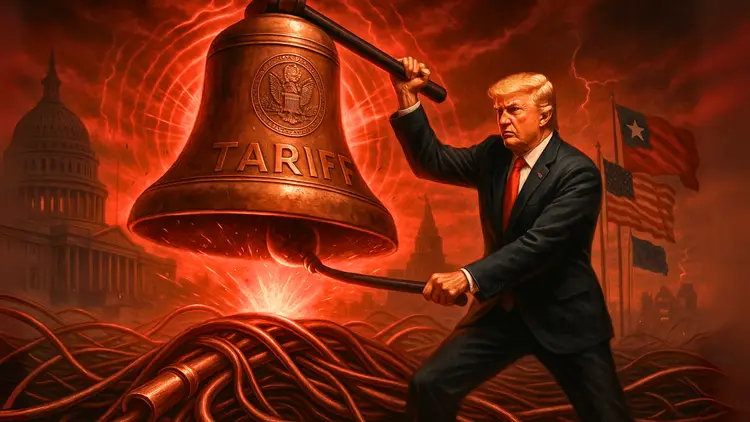
President Donald Trump has once again jolted global commodity markets with a headline-making move, this time targeting the red metal that powers everything from electric vehicles to infrastructure. In a surprise proclamation on Wednesday, Trump announced a 50 percent tariff on specific copper imports into the United States, narrowing the scope to cover only semi-finished copper goods like pipes and wiring. While this decision sent immediate shockwaves through the futures market, its real-world impact may be more nuanced than initially feared.
The market had braced for a sweeping blow. Earlier in July, Trump hinted that an across-the-board tariff on copper was imminent. Traders and analysts interpreted that as a potential full-spectrum levy on everything from copper ores and concentrates to refined cathodes and scrap. When Wednesday’s proclamation landed, however, it became clear that the administration had decided to hold its fire—for now. The tariffs, which come into effect Friday, will spare raw input materials like copper cathodes, anodes, mattes, scrap and concentrates. That’s a relief for global copper giants like Chile’s Codelco and Peru’s Southern Copper, who dominate the export of these early-stage products.
Instead, the levy will focus squarely on copper pipes, tubing, and other semi-finished copper products—industrially processed materials that U.S. manufacturers often import rather than make domestically. According to the White House proclamation, the decision followed a Section 232 national security investigation that concluded certain copper imports threaten to impair the United States’ defense readiness and economic resilience. The report, submitted on June 30 by Commerce Secretary Howard Lutnick, advised immediate action to protect critical supply chains.
In typical Trump fashion, the language of the announcement was forceful. “Copper is being imported into the United States in such quantities and under such circumstances as to threaten to impair the national security of the United States,” the proclamation declared. The move is aligned with Trump’s broader America First economic doctrine, which seeks to reduce U.S. dependence on foreign manufacturing and raw materials in sectors deemed vital to national interest.
The markets reacted with whiplash. U.S. Comex copper futures dropped 19.5 percent within hours of the announcement, quickly erasing a premium that had developed over the global London Metal Exchange (LME) benchmark. That premium had grown amid expectations that American copper producers like Freeport-McMoRan would see demand surge under a blanket tariff. Instead, the policy shift was more of a scalpel than a sledgehammer. The selloff underscores how much speculation had been priced in.
Freeport-McMoRan, which operates some of the largest copper mines in Arizona and New Mexico, said it would withhold comment until it had reviewed the full text of the order. Still, analysts say the company could see modest tailwinds as domestic demand shifts toward American-made piping and wiring. The bigger winners, however, may be foreign producers who dodged a bullet. Chile’s Codelco praised the exclusion of cathodes, which represent a significant chunk of its U.S.-bound exports. BHP, operator of the world’s largest copper mine—Escondida in Chile—and Antofagasta, another Chilean major, also appear to have avoided direct impact. Their silence, however, suggests they’re still assessing longer-term implications.
The tariffs aren’t just about trade. The order includes measures to bolster the domestic industry beyond tariffs alone. One clause requires that at least 25 percent of high-quality copper scrap generated within the U.S. be retained for domestic sale. That move could shift pricing dynamics in the scrap market and is likely to be closely watched by recyclers and manufacturers alike.
Looking forward, the Trump administration left the door wide open to additional action. The proclamation tasks Commerce Secretary Lutnick with delivering a follow-up assessment on the domestic copper market by June 2026. Based on that update, the President will consider introducing a phased universal tariff on refined copper starting at 15 percent in 2027, climbing to 30 percent by 2028. That forward guidance ensures that copper remains in the crosshairs and gives domestic industry time to prepare—or reposition.
The geopolitical backdrop makes this move even more significant. Copper isn’t just an industrial metal—it’s the backbone of electrification. As nations compete to secure their energy transitions, control over copper supply chains is becoming a matter of strategic leverage. China currently dominates global copper refining and manufacturing. Trump’s action, while targeted, sends a clear signal that the U.S. will fight to reclaim ground in this critical space. It also puts pressure on allies like Canada, where trade talks with the U.S. are already strained due to lingering steel and aluminum tariffs.
For Canadian officials, the announcement complicates negotiations. Less than two weeks remain before the self-imposed deadline to resolve disputes over tariffs on other key metals. Now, with copper suddenly on the table, those conversations could become more contentious. International trade lawyers warn that while this copper tariff isn’t as disruptive as it could have been, it sets a precedent. Washington is willing to weaponize tariffs in sectors it considers vital—and copper clearly qualifies.
Gracelin Baskaran, director of the Critical Minerals Security Program at the Center for Strategic and International Studies, summed it up succinctly: “The newly announced copper tariffs are far from the universal tariffs that markets were concerned about. It’s less punitive than initially expected.” Still, the fact remains—copper has officially entered the political arena. And that’s a game-changer.
The broader implications extend well beyond commodities markets. With Trump leaning into industrial policy and reasserting national security as justification for protectionist trade moves, other materials—nickel, lithium, rare earths—may not be far behind. Copper, in this case, was the canary in the mine. And now that it’s chirped, everyone else should be paying attention.
Conclusion
Trump’s copper tariff may not be the sledgehammer markets feared, but it’s a calculated shot across the bow. Focused on semi-finished products, the move is designed to nurture domestic manufacturing without completely severing global supply chains. For producers like Freeport-McMoRan, there’s opportunity. For exporters like Codelco and BHP, there’s relief. But make no mistake—this is only the opening act. With 2026 and 2027 deadlines already sketched into the proclamation, the administration has built a runway for future escalation. National security is now the north star guiding U.S. trade strategy, and copper just became its latest compass point.