
No Ticket to Beijing: How President Trump’s Grounded Trip Could Snarl Global Supply Chains
As geopolitical gridlock in the Middle East sends energy prices soaring, the ripple effects are threatening the fragile US-China trade truce and the global tech supply chain.
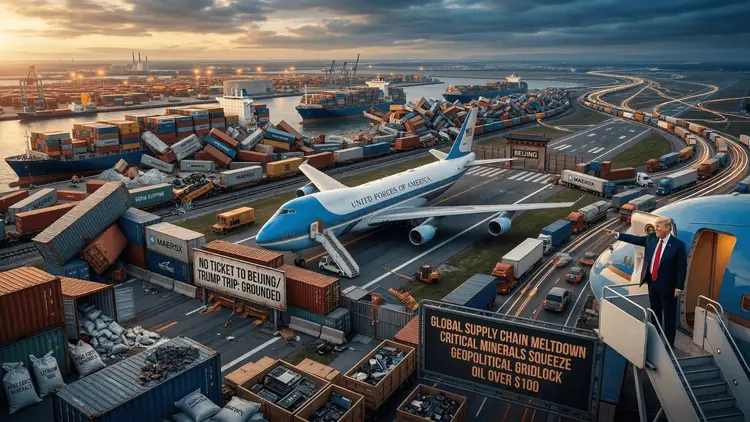
Forget the proverbial butterfly flapping its wings. When a critical Middle Eastern shipping lane closes and the President of the United States hints at pausing diplomatic travel to Beijing, the global economic weather turns violent immediately. With the Strait of Hormuz effectively shut down amid the ongoing conflict in Iran, crude oil has blasted past the psychological barrier of $100 a barrel. This geopolitical powder keg is threatening to upend everything from energy titans to the fragile, China-dominated critical minerals supply chain that powers modern tech.
The immediate casualty of the Iranian conflict is global logistics. The Strait of Hormuz is the world's most vital maritime choke point for oil, and its closure has triggered an aggressive crude rally. While domestic energy producers like ExxonMobil Corporation (NYSE: XOM) and Chevron Corporation (NYSE: CVX) might see short-term windfalls from surging prices, the downstream effects are entirely less celebratory for the broader economy. High energy costs act as a punitive tax on almost every industrial sector, drastically elevating the cost of extracting, refining, and shipping heavy raw materials globally.
Adding fuel to the fire is the precarious state of US-China relations. Treasury Secretary Scott Bessent has insisted that any delay to President Trump's upcoming summit with Chinese President Xi Jinping is purely a logistical necessity to oversee the Iranian situation from Washington. Yet, Trump himself suggested the trip hinges on whether Beijing will deploy its navy to help reopen the Strait. This high-stakes diplomatic standoff has placed the critical minerals market on high alert. China currently holds a stranglehold on the processing of rare earth elements, lithium, and cobalt. Should Beijing weaponize this leverage in response to US pressure, it could trigger devastating supply chain bottlenecks. Domestic and allied critical mineral players, such as Albemarle Corporation (NYSE: ALB) and MP Materials Corp. (NYSE: MP), find themselves navigating an incredibly volatile landscape where geopolitical leverage dictates commodity availability.
This strain is already radiating outward to the technology and automotive sectors. Mega-cap innovators heavily reliant on consistent critical mineral inputs, such as Apple Inc. (NASDAQ: AAPL) and Tesla Inc. (NASDAQ: TSLA), face the dual threat of soaring logistical expenses from $100 oil and potential export restrictions from China. Margins are poised to compress unless the geopolitical temperature cools rapidly. Conversely, the push for an international maritime coalition is driving capital toward the defense sector. Contractors like Lockheed Martin Corporation (NYSE: LMT) and General Dynamics Corporation (NYSE: GD) typically see heightened investor interest when international shipping lanes require naval escorts.
However, assembling that international coalition is proving difficult. Japan has firmly opted out of maritime involvement, and President Trump recently dismissed naval support from the United Kingdom, claiming the US does not need allies to join after the heavy lifting is done. With Iran reportedly allowing Chinese energy shipments to pass unhindered, Beijing has zero economic incentive to commit warships to the Gulf. Until the logjam in the Strait of Hormuz is cleared and the US-China trade truce is definitively secured, investors should brace for a market environment where uncertainty is the only reliable asset.