SPONSORED

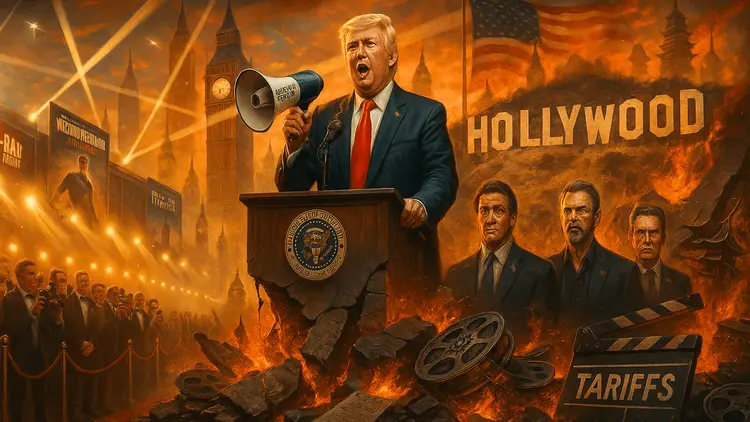
Lights, Camera, Tariffs! President Trump’s Plan Puts Hollywood in a Plot Twist

Trump’s Tariff Gambit Threatens to Rewrite Hollywood’s Global Playbook
•• 3 Min
Lights, Camera, Tariffs! President Trump’s Plan Puts Hollywood in a Plot Twist

Lights, camera, tariffs! In a plot twist that could rival any Hollywood thriller, President Donald J. Trump, the 47th and current President of the United States, sent shockwaves through the entertainment industry with a bombshell announcement on Truth Social late Sunday. His plan? A staggering 100% tariff on all foreign-produced films, a move that sent Netflix (NFLX), Warner Bros. Discovery (WBD), and Paramount Global (PARA) stocks plummeting as markets opened Monday. By midday, Netflix was nursing a nearly 2% drop, with Warner Bros. and Paramount each down about 1%, while Disney (DIS) held steady, seemingly unfazed—for now.

Trump’s Hollywood Crusade: A Tariff Tantrum or Strategic Strike?

With his signature bravado, President Trump didn’t hold back. “The Movie Industry in America is DYING a very fast death,” he proclaimed, pointing the finger at foreign governments dangling tax incentives to lure American studios overseas. He framed it as nothing less than a “concerted effort” by other nations—an economic and cultural assault that he deems a “National Security threat.” His fix? Slap a 100% tariff on any film not shot on U.S. soil, a policy that’s left Tinseltown reeling faster than a bad opening weekend.

15afdaa0-29ae-11f0-8f76-3e2c25c52363.png

The industry, still dusting itself off from writers’ and actors’ strikes and the pandemic’s lingering hangover, was caught flat-footed. Hollywood veterans wasted no time clapping back. Chris Fenton, a seasoned exec, warned that such a sweeping tariff could grind production to a halt, echoing the gridlock of recent labor disputes. Kathryn Arnold, a film producer with decades in the game, didn’t mince words, calling the tariffs “insane and devastating.” She painted a bleak picture: mid-budget films crushed, studios forced to swallow skyrocketing domestic labor and production costs, and a ripple effect that could leave crews jobless and vendors boarded up.

Blockbusters in the Crosshairs: From Avengers to Avatar

If Trump’s tariff threat becomes reality, the collateral damage could read like a summer release schedule. Disney’s Avengers: Doomsday and Spider-Man: Brand New Day, both shot abroad, are squarely in the firing line. Paramount’s Mission: Impossible — The Final Reckoning, filmed across multiple countries, isn’t safe either. James Cameron’s Avatar: Fire and Ash, a New Zealand production, and Lionsgate’s Ballerina, lensed in the Czech Republic, face the same peril. Even Lucasfilm’s upcoming Star Wars chapter, Starfighter, with its UK roots, could feel the squeeze. The global filming model—built on co-productions, foreign tax breaks, and location-driven storytelling—now hangs in the balance.

Let’s talk dollars and sense. Hollywood’s bottom line thrives on international markets. Pre-COVID, China alone accounted for up to 40% of global box office revenue, though U.S. studios typically pocketed just a quarter of that due to revenue-sharing rules. Even so, foreign markets often drive 60–70% of a film’s total haul, keeping studios afloat when domestic audiences ghost them. Trump’s claim that the U.S. film industry is “dying” ignores a key stat: it’s a net export business, with American movies and TV shows dominating global culture, according to the Motion Picture Association.

But here’s the rub: tariffs cut both ways. If the U.S. slaps duties on foreign-made films, other nations could retaliate, blocking American releases, throttling streaming platforms like Netflix and Disney+, or slashing revenue-sharing deals. A cultural trade war could erupt, with Hollywood’s global streamers caught in the crossfire.

Netflix Feels the Heat, Wall Street Freaks Out

Monday’s market meltdown told the story. Netflix, the poster child for global production, took the hardest hit. With 30% of its audience hooked on film content and a chunk of its originals shot overseas, the streamer faces a potential cost explosion. Morgan Stanley’s Ben Swinburne threw up his hands, noting that the tariffs’ murky structure makes their impact “virtually impossible” to pin down. Will they hit only theatrical releases? Streaming titles? Co-productions? For now, it’s a guessing game, and Wall Street hates uncertainty. The S&P 500’s 5% nosedive Thursday, its worst since June 2020, was partly pinned on Trump’s tariff blitz.

Adding a surreal twist, Trump recently assembled a so-called Hollywood revival team, tapping actors Jon Voight, Sylvester Stallone, and Mel Gibson as cultural envoys. It’s a symbolic flex, but it underscores how deeply politicized Hollywood has become in Trump’s orbit. For the President, the decline of domestic film production isn’t just economic—it’s a cultural and national security crisis. He’s betting on reviving what he sees as America’s fading storytelling empire, even if it means torching the globalized model that’s kept Hollywood humming.

Soft Power at Stake: Hollywood’s Global Grip

This isn’t just about budgets or box office. Hollywood is America’s ultimate soft-power weapon, its cultural reach unmatched. From Top Gun to The Avengers, U.S. films shape global perceptions. If tariffs force studios to retreat to American soil—at a premium—or face crippling duties, that dominance could wobble. It’s a high-stakes gamble: short-term pain for long-term gain, or a misstep that hands cultural influence to rivals like China or Europe.

Here’s the kicker: Hollywood is the ultimate survivor. It’s outlasted wars, recessions, and the shift from celluloid to streaming. Whether Trump’s tariffs materialize or fizzle, studios will pivot—scouting tax loopholes, rethinking what counts as “foreign production,” or doubling down on U.S. territories like Puerto Rico. But the message is clear: the rules have changed. Politics and pop culture are now inseparable, and every studio exec from Burbank to Brooklyn is sweating the next scene.

A Cliffhanger for the Ages

President Trump’s 100% tariff threat may still be a tweetstorm, not law, but its tremors are real. Netflix, Warner Bros., and Paramount are already feeling the pinch, and the ripple effects could rewrite production schedules, global release strategies, and Hollywood’s very DNA. Whether this is a calculated policy to resurrect American filmmaking or a political jab to rile up his base, one thing’s certain: the entertainment industry is now a frontline in Trump’s America First agenda. Grab your popcorn—this drama’s just getting started.

Donald TrumpNetflix

Most Popular News

  1. SpaceX’s $8B Spectrum Deal Sends AT&T, Verizon, and T-Mobile Plummeting
  2. Is Project Vault Securing America’s Supply Chain or Squeezing It to the Breaking Point?
  3. Why Gautam Lohia Shifted from Global Consulting to Reboot a $20M Tech Micro-Cap
  4. Everyday Luxury, Unstoppable Scale: Aritzia Delivers 44% Net Revenue Growth
  5. Can Navy SEAL Leadership and Big Tech Scale Revolutionize Airborne Threat Detection?

Disclaimer


This report should not be viewed as investment advice or as an offer to buy or sell any securities or as an invitation or solicitation of an offer to buy or sell any securities. Neither the author of this report, its publisher, nor any other person associated with the publication of this report, are registered brokers, investment dealers, investment advisers, or financial advisers. The information in this report has not been tailored to the particular needs or circumstances of readers and should not be relied upon as investment advice or recommendations to purchase or sell any of the securities presented in this report. Readers seeking investment advice should contact qualified and registered brokers, investment dealers, investment advisers, or financial advisers prior to making any decision to buy or sell any of the securities referred to in this report. The information in this report should not be construed as investment, legal, or tax advice. No recommendation is made as to whether an investment in the presented securities is suitable for any reader in light of the reader’s particular circumstances.

Readers are cautioned that the publisher of this report covers exclusively securities that carry a high degree of volatility. Investing in such securities is highly speculative and carries a high degree of risk. Investors in such securities could lose all or a substantial portion of their investment. Only those investors who can afford to lose all or a substantial portion of their investment should consider investing in the securities referred to in this report.

This report may include information obtained from publicly available sources, including third-party reports or analysis. Neither the author nor publisher of this report, nor www.juniorstocks.com or its owners, have undertaken any independent investigation into the factual information used in this report, and the information in this report is provided without any warranty of any kind. No representations or warranties are provided regarding the accuracy or completeness of the information provided in this report. Statements of opinion or belief are those of the authors and/or publisher of this report. These statements of opinion or belief are expressions of the author’s and/or publisher’s judgment, and there is no guarantee that those judgments will turn out to be correct. No inference should be drawn that the author and/or publisher have any special or greater knowledge about the presented companies or their securities, or any particular expertise in the industries or markets in which the company operates. Readers should conduct their own due diligence and seek professional advice prior to investing in any securities presented on Juniorstocks.com.

Certain statements in this report constitute “forward-looking” statements. Forward-looking statements often, but not always, are identified by the use of words such as “seek,” “anticipate,” “believe,” “plan,” “estimate,” “expect,” “targeting,” and “intend” and statements that an event or result “may,” “will,” “should,” “could,” or “might” occur or be achieved and other similar expressions. Forward-looking statements express or involve discussions with respect to predictions, expectations, beliefs, plans, projections, objectives, goals, assumptions, or future events or performance; they are not statements of historical facts and should not be viewed as any guarantee of any future result. Forward-looking statements are based on expectations, estimates, and projections at the time the statements are made that involve a number of risks and uncertainties which could cause actual results or events to differ materially from those presently anticipated. The author and/or publisher of this report disclaims any obligation to update the forward-looking statements in this report, whether as a result of new information, future events, or results or otherwise. There is no assurance that forward-looking statements will prove to be accurate, as actual results and future events could differ materially from those anticipated in such statements. Accordingly, readers should not place undue reliance on forward-looking statements.

The information provided in this report is not intended for distribution to, or use by, any person or entity in any jurisdiction or country where such distribution or use would be contrary to applicable law or regulation, or would subject the author or publisher of this report to any registration requirement in such jurisdiction or country.

Information about the editor of this publication:
Juniorstocks.com is a service provided by Piccadilly Capital Group, Office 66, 101 Clapham High Street, London, SW4 7TB, UK. Piccadilly Capital Group is not the publisher of this report and was not paid for the publication of this report. Piccadilly Capital Group seeks to generate web traffic and a growing number of followers through the publication of articles or reports. Directors, officers, and other insiders of the publisher own an interest in Piccadilly Capital Group. Piccadilly Capital Group does not endorse or recommend the business, products, services, or securities of any company mentioned on www.juniorstocks.com. Piccadilly Capital Group will not share your information with any outside third parties. Due to the new data protection basic regulation, we ask you to read our data protection declaration carefully.

Note on copyright:
The contents published on this website and on connected media (e.g., e-mail, X, Facebook) are subject to applicable copyright and ancillary copyright laws. Any use not permitted by applicable copyright and ancillary copyright laws requires the prior written consent of the provider or the respective rights holder. In particular, this applies to the duplication, editing, translation, storage, processing, or reproduction of content in databases or other electronic media and systems. Contents and rights of third parties are marked as such. Unauthorized reproduction or transmission of individual contents or complete pages is not permitted and is punishable by law. Only the production of copies and downloads for personal, private, and non-commercial use is permitted. Links to the provider's website are always welcome and do not require the consent of the provider of the website. Photos and images on the website may not be shared unless the publisher itself has acquired the initial rights from authorized sources. The presentation of this website in external frames is only allowed with written permission. If you notice any violations, please inform us. Please note: The content of our articles, emails, or other publications or social networks such as X, LinkedIn or Facebook is exclusively intended for the designated addressee(s). If you are not the addressee of these articles, emails, or other publications in the market letter or social networks such as Twitter or Facebook or his or her legal representative, please note that any form of publication, reproduction, or distribution of the content of these articles, emails, or other publications in the market letter or social networks such as X, LinkedIn or Facebook is prohibited. Falsifications of the original content of this message during data transmission cannot be excluded in principle.