SPONSORED

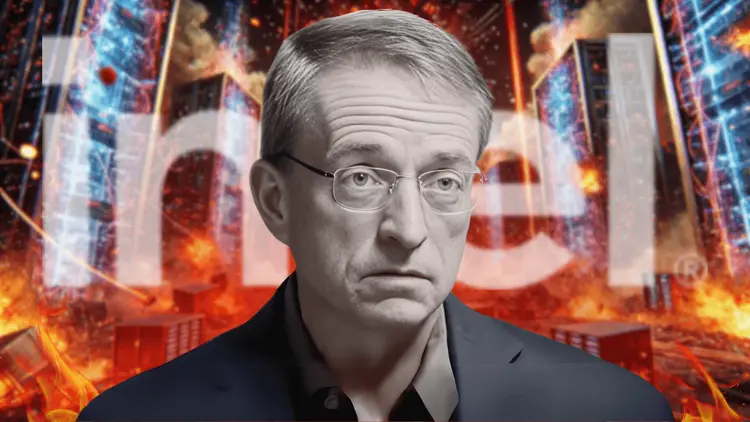
Intel CEO Pat Gelsinger Forced Out Amid Struggles to Close the AI Gap.

Intel’s Leadership Shake-Up Sparks Questions About Future Strategy and AI Competitiveness.
•• 3 Min
Intel CEO Pat Gelsinger Forced Out Amid Struggles to Close the AI Gap.

Intel's CEO Pat Gelsinger has been ousted following increasing dissatisfaction among board members regarding the company’s progress in regaining market dominance and narrowing the technological gap with competitors like Nvidia Corp. The announcement marks a pivotal moment in Intel’s tumultuous journey to restore its former glory.

The End of Gelsinger’s Tenure

The decision to replace Gelsinger came after Intel’s board expressed concerns over the company’s stagnation in key markets. According to sources, Gelsinger was presented with the option to retire or face removal. Opting for retirement, the 63-year-old executive announced the end of his career at Intel.

To ensure continuity, Intel has appointed Chief Financial Officer David Zinsner and product CEO Michelle Johnston Holthaus as interim co-CEOs. Meanwhile, Frank Yeary, Intel's independent board chair, has assumed the role of interim executive chair, signaling a period of leadership transition.

Gelsinger’s Legacy at Intel

Returning to Intel in 2021 after a successful stint as VMware’s CEO, Gelsinger was hailed as a savior for the company. With a deep connection to Intel—dating back to his teenage years—he vowed to restore the chipmaker’s dominance in the semiconductor industry.

Gelsinger spearheaded a bold strategy to expand Intel’s manufacturing capabilities, including a massive $28 billion chip facility in Ohio. This initiative was part of his broader vision to challenge industry titans like TSMC and Samsung Electronics in custom chip production.

Intel’s Struggles Under Gelsinger

Despite Gelsinger’s efforts, Intel continued to lose ground to rivals like Nvidia, which capitalized on AI advancements to dominate data center graphics chips. Intel's inability to break into the AI chip market exacerbated its challenges.

The company’s financial woes came to light during its disastrous August earnings report, which revealed a surprise loss and a grim sales forecast. Intel also suspended its dividend for the first time since 1992 and announced layoffs affecting over 15% of its workforce.

Broader Implications of Gelsinger’s Exit

Industry analysts believe Gelsinger’s departure could pave the way for a more dramatic overhaul of Intel’s strategy. Chris Caso of Wolfe Research suggested that Intel may need to reconsider its position as a leading-edge manufacturer.

Intel's struggles represent a significant setback for the Biden administration’s efforts to revitalize domestic chip production through the Chips and Science Act. Intel had been a major beneficiary of the program, receiving $7.9 billion in federal grants.

The Challenges Ahead

Michelle Johnston Holthaus, now also CEO of Intel’s product group, faces the daunting task of steering the company through a critical juncture. Her focus will be on strengthening Intel’s core product lines, including client computing, data centers, and AI.

The board has emphasized the need to restore investor trust. Frank Yeary stated, “We know we have much more work to do and are committed to delivering for our customers.”

Intel’s next leader will need to address its lagging position in the AI sector, where Nvidia has become the unassailable leader. Regaining relevance in this space will be critical to Intel’s future.

Key Takeaways

  • Leadership Change at a Critical Time: Gelsinger’s ousting signals dissatisfaction with Intel’s progress in regaining market share and tackling financial instability.
  • Strategic Uncertainty: The company faces questions about whether it can continue as a leading-edge manufacturer.
  • National Impact: Intel’s struggles could undermine U.S. efforts to rebuild domestic semiconductor manufacturing.

Conclusion

Pat Gelsinger’s exit marks the end of a chapter for Intel as the company navigates one of the most challenging periods in its history. With interim leadership at the helm and strategic uncertainties looming, Intel’s next steps will determine whether it can reclaim its place as a semiconductor leader.

Intel

Most Popular News

  1. SpaceX’s $8B Spectrum Deal Sends AT&T, Verizon, and T-Mobile Plummeting
  2. Is Project Vault Securing America’s Supply Chain or Squeezing It to the Breaking Point?
  3. Why Gautam Lohia Shifted from Global Consulting to Reboot a $20M Tech Micro-Cap
  4. Everyday Luxury, Unstoppable Scale: Aritzia Delivers 44% Net Revenue Growth
  5. Can Navy SEAL Leadership and Big Tech Scale Revolutionize Airborne Threat Detection?

Disclaimer


This report should not be viewed as investment advice or as an offer to buy or sell any securities or as an invitation or solicitation of an offer to buy or sell any securities. Neither the author of this report, its publisher, nor any other person associated with the publication of this report, are registered brokers, investment dealers, investment advisers, or financial advisers. The information in this report has not been tailored to the particular needs or circumstances of readers and should not be relied upon as investment advice or recommendations to purchase or sell any of the securities presented in this report. Readers seeking investment advice should contact qualified and registered brokers, investment dealers, investment advisers, or financial advisers prior to making any decision to buy or sell any of the securities referred to in this report. The information in this report should not be construed as investment, legal, or tax advice. No recommendation is made as to whether an investment in the presented securities is suitable for any reader in light of the reader’s particular circumstances.

Readers are cautioned that the publisher of this report covers exclusively securities that carry a high degree of volatility. Investing in such securities is highly speculative and carries a high degree of risk. Investors in such securities could lose all or a substantial portion of their investment. Only those investors who can afford to lose all or a substantial portion of their investment should consider investing in the securities referred to in this report.

This report may include information obtained from publicly available sources, including third-party reports or analysis. Neither the author nor publisher of this report, nor www.juniorstocks.com or its owners, have undertaken any independent investigation into the factual information used in this report, and the information in this report is provided without any warranty of any kind. No representations or warranties are provided regarding the accuracy or completeness of the information provided in this report. Statements of opinion or belief are those of the authors and/or publisher of this report. These statements of opinion or belief are expressions of the author’s and/or publisher’s judgment, and there is no guarantee that those judgments will turn out to be correct. No inference should be drawn that the author and/or publisher have any special or greater knowledge about the presented companies or their securities, or any particular expertise in the industries or markets in which the company operates. Readers should conduct their own due diligence and seek professional advice prior to investing in any securities presented on Juniorstocks.com.

Certain statements in this report constitute “forward-looking” statements. Forward-looking statements often, but not always, are identified by the use of words such as “seek,” “anticipate,” “believe,” “plan,” “estimate,” “expect,” “targeting,” and “intend” and statements that an event or result “may,” “will,” “should,” “could,” or “might” occur or be achieved and other similar expressions. Forward-looking statements express or involve discussions with respect to predictions, expectations, beliefs, plans, projections, objectives, goals, assumptions, or future events or performance; they are not statements of historical facts and should not be viewed as any guarantee of any future result. Forward-looking statements are based on expectations, estimates, and projections at the time the statements are made that involve a number of risks and uncertainties which could cause actual results or events to differ materially from those presently anticipated. The author and/or publisher of this report disclaims any obligation to update the forward-looking statements in this report, whether as a result of new information, future events, or results or otherwise. There is no assurance that forward-looking statements will prove to be accurate, as actual results and future events could differ materially from those anticipated in such statements. Accordingly, readers should not place undue reliance on forward-looking statements.

The information provided in this report is not intended for distribution to, or use by, any person or entity in any jurisdiction or country where such distribution or use would be contrary to applicable law or regulation, or would subject the author or publisher of this report to any registration requirement in such jurisdiction or country.

Information about the editor of this publication:
Juniorstocks.com is a service provided by Piccadilly Capital Group, Office 66, 101 Clapham High Street, London, SW4 7TB, UK. Piccadilly Capital Group is not the publisher of this report and was not paid for the publication of this report. Piccadilly Capital Group seeks to generate web traffic and a growing number of followers through the publication of articles or reports. Directors, officers, and other insiders of the publisher own an interest in Piccadilly Capital Group. Piccadilly Capital Group does not endorse or recommend the business, products, services, or securities of any company mentioned on www.juniorstocks.com. Piccadilly Capital Group will not share your information with any outside third parties. Due to the new data protection basic regulation, we ask you to read our data protection declaration carefully.

Note on copyright:
The contents published on this website and on connected media (e.g., e-mail, X, Facebook) are subject to applicable copyright and ancillary copyright laws. Any use not permitted by applicable copyright and ancillary copyright laws requires the prior written consent of the provider or the respective rights holder. In particular, this applies to the duplication, editing, translation, storage, processing, or reproduction of content in databases or other electronic media and systems. Contents and rights of third parties are marked as such. Unauthorized reproduction or transmission of individual contents or complete pages is not permitted and is punishable by law. Only the production of copies and downloads for personal, private, and non-commercial use is permitted. Links to the provider's website are always welcome and do not require the consent of the provider of the website. Photos and images on the website may not be shared unless the publisher itself has acquired the initial rights from authorized sources. The presentation of this website in external frames is only allowed with written permission. If you notice any violations, please inform us. Please note: The content of our articles, emails, or other publications or social networks such as X, LinkedIn or Facebook is exclusively intended for the designated addressee(s). If you are not the addressee of these articles, emails, or other publications in the market letter or social networks such as Twitter or Facebook or his or her legal representative, please note that any form of publication, reproduction, or distribution of the content of these articles, emails, or other publications in the market letter or social networks such as X, LinkedIn or Facebook is prohibited. Falsifications of the original content of this message during data transmission cannot be excluded in principle.