
HODL Till Retirement: Trump Just Made It Official
Trump's executive order could turn crypto into a mainstream retirement asset, unlocking billions in potential demand from 401(k) plans across America.
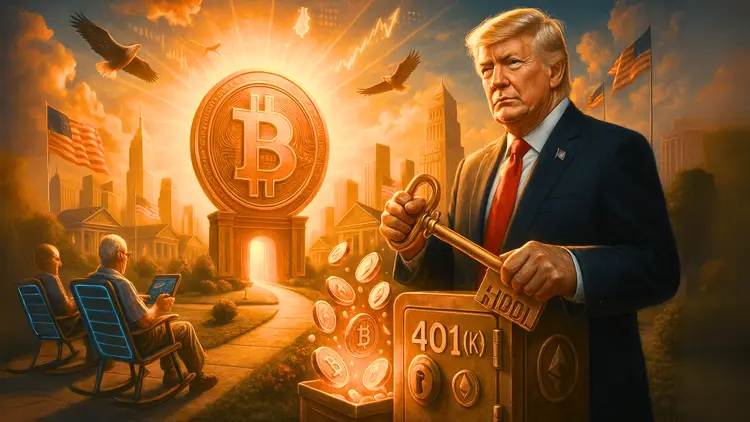
President Donald Trump is expected to sign a sweeping executive order that could fundamentally alter the American retirement system. The order, aimed at reshaping the landscape of 401(k) investment options, would allow for the inclusion of alternative assets such as private equity, real estate, and most notably, cryptocurrencies like Bitcoin and Ethereum. The decision marks a historic pivot in the U.S. government’s stance on digital assets, signaling growing institutional acceptance and opening the floodgates for a new era of financial experimentation in retirement planning.
This isn’t just a regulatory tweak, it's a seismic shift. Cryptocurrencies have long hovered at the fringe of mainstream finance, celebrated by tech futurists and maligned by cautious regulators. Now, they’re being invited into the heart of America’s most trusted retirement vehicle. The inclusion of crypto into 401(k)s will undoubtedly give millions of Americans a direct stake in the performance of digital assets, changing both how portfolios are built and how crypto markets behave.
The implications for Bitcoin, Ethereum, and the broader altcoin ecosystem are enormous. With BTC-USD and ETH-USD already climbing following the news, traders and long-term investors alike are recalibrating their strategies. According to BlackRock's head of digital assets Robbie Mitchnick, this development could serve as a legitimizing force for crypto in diversified portfolios, especially as a hedge against tail-risk events that traditional assets may not cover effectively.
Mitchnick emphasized that while this policy shift is encouraging, it must be accompanied by serious investor education. There’s no denying the volatility that has defined crypto markets, and allocating a portion of retirement savings to such assets without understanding the risks could prove disastrous. But for those willing to learn, the reward could be monumental. Crypto, as Mitchnick puts it, offers a unique form of diversification, especially as it exists outside the confines of sovereign fiscal policy and central bank manipulation.
Bitcoin has outperformed every traditional asset class over the past decade. Yet, until now, it has been largely excluded from the tax-advantaged frameworks that power retirement growth for most Americans. With the executive order, that wall is crumbling. The opportunity to include crypto within a 401(k) could also provide major tax efficiencies, especially for those sitting on significant unrealized gains. Investors would no longer need to worry about triggering capital gains taxes when reallocating funds into crypto, a move that could spur new inflows and reduce friction across the space.
There are still skeptics, of course. Critics argue that the decision introduces unnecessary risk into a system meant to provide stable, long-term returns. Others worry that mainstream exposure to such a volatile asset could undermine confidence in the broader retirement ecosystem. But history shows that disruptive technologies are always met with doubt before they are embraced. From internet stocks in the 90s to the rise of ETFs in the 2000s, financial innovation often begins at the margins before becoming the norm.
What makes this moment different is timing. The world is shifting toward decentralized finance, and the U.S. is eager not to fall behind. Countries like Switzerland and Singapore have already created frameworks for institutional crypto investment. The Trump administration appears determined to ensure that America doesn’t just catch up, but leads.
The executive order is also expected to touch on other alternative investments like real estate and private equity, both of which have long been coveted for their returns and inflation hedging potential. But it's crypto that’s grabbing the headlines. That’s because this isn’t just about financial engineering, it’s about access. Giving everyday Americans a chance to own Bitcoin through their retirement accounts democratizes an asset that was once considered niche, even fringe.
There are questions about how adoption will unfold. Some analysts believe the pace will be slow and cautious, with only a handful of plans incorporating crypto in the early stages. Others think we’re on the cusp of a major wave. If every 401(k) plan added just a 1 to 2 percent allocation to digital assets, the impact on the market could be exponential. We’re talking hundreds of billions in potential inflows.
Mitchnick argues that the key determinant of adoption will be education and perception. The crypto space operates on two levels. The first is retail, fast-moving, often speculative, and deeply influenced by social media sentiment. The second is institutional, slower, more deliberate, and long-term focused. The latter group, he says, sees Bitcoin not as a tech bet or meme asset, but as a foundational holding akin to digital gold. It’s this cohort that will drive sustainable adoption, especially within retirement frameworks.
Another layer to this story is interest rates. Bitcoin, like gold, tends to move inversely to real interest rates. As the Federal Reserve weighs potential cuts, analysts expect crypto prices to benefit. Lower rates typically weaken the dollar and boost demand for alternative assets, including Bitcoin. The alignment of this macro trend with regulatory support could create a perfect storm for upward momentum in the space.
But this doesn’t mean Bitcoin is suddenly a risk-free asset. In fact, one of the biggest challenges will be how investors mentally categorize it. Is it a hedge or a high-growth asset? A safe haven or a speculative bet? The answer, ironically, depends on the investor. For some, it will be a small diversifier, a way to protect against fiat currency risk. For others, it will represent a moonshot opportunity. Either way, the narrative around crypto in traditional portfolios is being rewritten in real time.
Some crypto veterans warn against overreliance on old frameworks. For years, the four-year halving cycle dominated Bitcoin market theory. Prices would soar post-halving, then cool off until the next. But today, those models appear outdated. The influence of ETFs, regulatory changes, and institutional demand have introduced new variables that are rendering past cycles obsolete. Supply-side dynamics are no longer the sole drivers. Instead, demand from traditional finance is becoming the primary engine.
Trump’s executive order also comes at a moment when ETFs like BlackRock’s iShares Bitcoin Trust (IBIT) are gaining traction. These investment vehicles are helping bridge the gap between crypto and Wall Street, offering exposure without the need to hold coins directly. With both ETFs and 401(k) plans now involved, the infrastructure to support mass adoption is rapidly taking shape.
Ultimately, this executive order represents more than just a policy change. It’s a statement. The federal government, under Trump’s leadership, is sending a clear message that crypto has a role to play in America’s financial future. And not just for speculators or Silicon Valley elites, but for everyday workers looking to grow their retirement savings.
Markets will take time to adjust. Advisors will need to retool their models. Plan sponsors will tread carefully. But the direction is set. Crypto has crossed the Rubicon. It’s no longer a question of if, but how much.
Conclusion
The inclusion of crypto in 401(k)s isn’t just a policy decision, it’s a cultural milestone. For years, digital assets were treated like a novelty. Today, they are being woven into the fabric of America’s financial system. Trump’s executive order may draw criticism and caution, but it also reflects a growing recognition that the future of finance is decentralized, digital, and disruptive. Whether investors choose to ride that wave or watch from the sidelines, the tide is turning—and fast.