
G7 and Allies Convene to Address Critical Mineral Dependency
Finance Ministers from the G7 and Key Allies Weigh Price Floors and New Partnerships to Break Beijing’s Grip on Critical Minerals
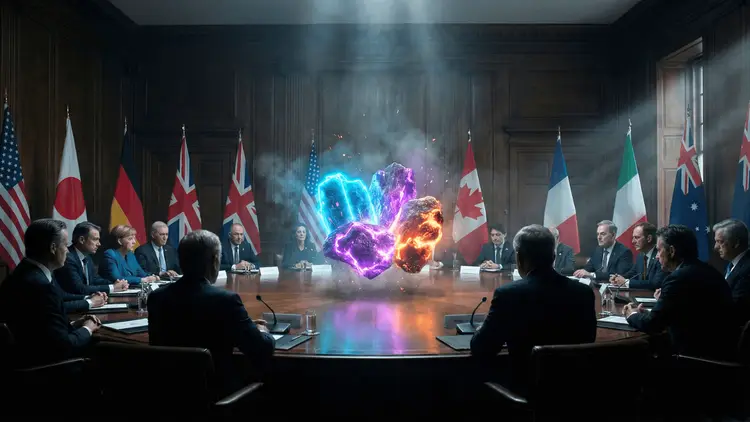
If you ever wondered what it takes to get the world’s staunchest free-market defenders to seriously consider global price-fixing, look no further than the bottom of the periodic table. On a crisp Monday in Washington, the finance chiefs of the G7 and a cadre of key allies gathered with a singular, slightly uncomfortable goal: figuring out how to quit their addiction to Chinese rare earth minerals without crashing the global economy in the process.
U.S. Treasury Secretary Scott Bessent played host to this high-stakes intervention, welcoming counterparts from the usual G7 suspects, Japan, Britain, France, Germany, Italy, and Canada, alongside representatives from Australia, Mexico, South Korea, and India. The guest list itself told the story. With these nations collectively accounting for 60% of global demand for critical minerals, the room represented a massive chunk of the world’s buying power, all looking for a new dealer.
The catalyst for this sudden urgency isn’t just vague supply chain anxiety; it is raw geopolitics. China currently holds a near-monopoly on the refining of essential minerals like copper, lithium, and cobalt, controlling anywhere from 47% to 87% of the market depending on the element. These aren't just rocks; they are the fundamental ingredients for everything from EV batteries to advanced defense systems. The stakes were sharpened last week when Beijing slapped a ban on exports of dual-use items to Japan, a move that undoubtedly focused minds in Tokyo and Washington.
While the gathered ministers stopped short of issuing a frantic joint statement, the Treasury noted that Bessent is pushing for "prudent de-risking over decoupling." In plain English, that means nobody is ready to completely sever ties with the world’s factory, but they are desperate to find a backdoor exit.
The proposed solutions were arguably the most interesting part of the day, specifically because they sound decidedly un-capitalist coming from this group. Japanese Finance Minister Satsuki Katayama, likely feeling the heat from the recent export bans, told reporters there was broad agreement on the need for swift action. She laid out a toolkit that included tax incentives, public financing, and, most notably, a "price floor." The logic here is simple but expensive: non-Chinese mines struggle to compete with Beijing’s subsidized output, so G7 nations might guarantee a minimum price to keep alternative projects alive. Katayama also floated the idea of creating markets based on "values," effectively charging a premium for minerals mined with respect for labor conditions and human rights.
However, not everyone in the room was ready to declare economic war. German Finance Minister Lars Klingbeil injected a dose of European pragmatism into the proceedings. While acknowledging that discussions on price floors had begun, he warned against forming an explicit "anti-China coalition." His message to his European colleagues was less about geopolitical maneuvering and more about internal competence. Klingbeil noted that complaining and self-pity wouldn't dig mines, urging the EU to "become active" through better financing and a massive ramp-up in recycling capabilities.
As the meeting wrapped up, it was clear that this was merely the opening salvo. With France set to take over the G7 presidency, critical minerals will remain headline news throughout the year. The West has finally admitted it has a supply problem, but as any economist will tell you, finding a solution is going to cost them.