
Deutsche Bank Predicts 50% Copper Rally to $22,050 as Global Supply Squeeze Looms
As global stockpiling accelerates and greenfield mine developments lag, major financial institutions clash over whether copper is headed for an unprecedented physical liquidity squeeze or a macro-driven surplus.
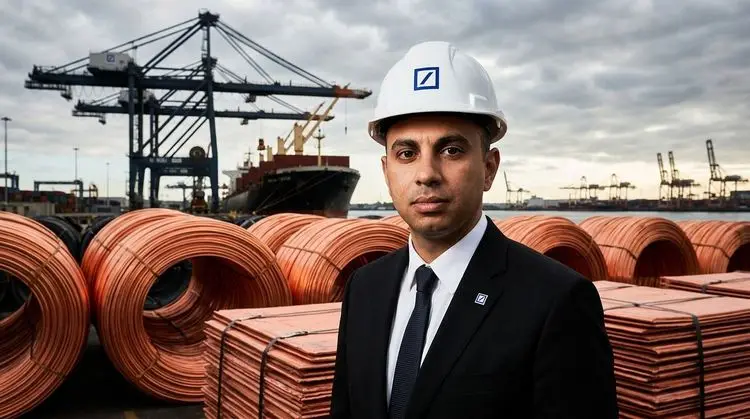
If you thought the global race for advanced microchips was intense, try running the modern economy without the metal that powers it all.
Deutsche Bank (ETR: DBK) has delivered a jolt to raw material markets, forecasting that copper prices could rocket 50% to an eye-watering $22,050 per metric ton by the second quarter of 2027.
Rather than a routine cyclical demand bump, Senior Metals Analyst Daniel Ghali frames the coming crunch as a full-blown physical supply liquidity crisis. Driven by a relentless strategic scramble, the United States and China are aggressive buyers in the physical spot market. According to Deutsche Bank estimates, accelerated national stockpiling could result in those two nations controlling roughly 71% of global copper supplies by the end of the year, leaving the rest of the world competing for a dwindling pool of available metal.
The underlying drivers feeding this market dynamic are as persistent as they are capital-intensive. AI-driven data center expansion, electric vehicle production, power grid modernizations, and renewable energy installations continue to demand vast quantities of conductor metal. However, mine supply operates on a completely different timeline. Developing a new greenfield copper mine from initial exploration to commercial production routinely takes 15 to 18 years. With mine outages and force majeure events hitting key operations in recent years, the global buffer has eroded to historic lows.
Deutsche Bank does not view a price spike as an isolated, temporary event. The bank projects average copper prices of $20,900 per metric ton across 2027, before settling at an average floor of $18,500 per metric ton in 2028. In Ghali’s analysis, available exchange inventories could drop toward zero unless prices climb high enough to ration demand or force industrial manufacturers toward lower-cost substitutes.
While Deutsche Bank stakes out the most bullish claim on Wall Street, other financial institutions offer varying assessments of how tight the physical market will remain. Analysts at Citi (NYSE: C) maintain a bullish 12-month price target of $15,000 per ton, pointing to persistent infrastructure deficits and data center power requirements. UBS Group (NYSE: UBS) aligns with the supply-constrained view, projecting $15,500 per ton by mid-2027 as mine disruptions linger.
Taking a more cautious stance, strategy teams at JPMorgan Chase (NYSE: JPM) warn that broader macroeconomic headwinds and sustained energy costs could dampen industrial buying. JPMorgan analysts suggest that if global growth falters, copper could face downside pressure toward $11,100 per ton. Similarly, researchers at Macquarie Group (ASX: MQG) and the International Copper Study Group point to potential supply surpluses exceeding 300,000 to 700,000 tonnes in 2027 and 2028, arguing that record prices will incentivize scrap recycling and bring deferred projects back online.
Producers on the front lines reinforce the thesis that expanding mine capacity is far easier said than done. Kathleen Quirk, Chief Executive Officer of Freeport-McMoRan (NYSE: FCX), has repeatedly emphasized the operational hurdles involved in bringing major new production online, noting that delivering an 800-million-pound copper operation takes years of sustained effort and heavy capital investment. Executives at BHP Group (NYSE: BHP) share that long-term optimism, forecasting that global copper consumption could expand by up to 70% over the next two decades as electrification replaces traditional industrial demand drivers.
As prices test unprecedented territory, market participants will closely watch whether industrial users begin substituting aluminum for copper in electrical applications where technically feasible. Whether high-tech data center construction maintains its frantic pace or faces budgetary reality checks will also decide if Deutsche Bank’s $22,050 vision becomes reality.
Sources
- Deutsche Bank Research, Global Metals & Mining Outlook, Daniel Ghali (September 2026).
- Citigroup Global Markets, Commodities Strategy & Metal Price Targets.
- JPMorgan Chase & Co. Global Commodities Research, Gregory Shearer & Dominic O'Kane.
- UBS Investment Bank, Global Base Metals Industry Analysis.
- Freeport-McMoRan Inc., Executive Market Commentary, CEO Kathleen Quirk.
- BHP Group, Long-Term Energy Transition & Commodities Outlook.
- International Copper Study Group (ICSG), Global Copper Supply & Demand Balances.
Disclaimer
Neither the author of this article nor JuniorStocks (juniorstocks.com) holds equity, stock options, or any other financial positions in Deutsche Bank (ETR: DBK), Citigroup (NYSE: C), UBS Group (NYSE: UBS), JPMorgan Chase (NYSE: JPM), Macquarie Group (ASX: MQG), Freeport-McMoRan (NYSE: FCX), BHP Group (NYSE: BHP), or any other companies mentioned in this publication. This content is published by JuniorStocks strictly for informational and educational purposes, was prepared independently without company compensation, and utilized AI assistance for research, drafting, text editing, and formatting. While industrial commodity forecasts and copper market dynamics represent compelling economic developments, this article does not constitute investment or financial advice. Readers and prospective investors are strongly advised to conduct their own thorough, independent due diligence and consult with a licensed financial professional before making any investment decisions.