
Can Global Markets Survive Iran's Threat of $200 Crude Oil?
With the Strait of Hormuz choked and military strikes escalating, global markets brace for unprecedented energy shocks while hoping for a diplomatic miracle.
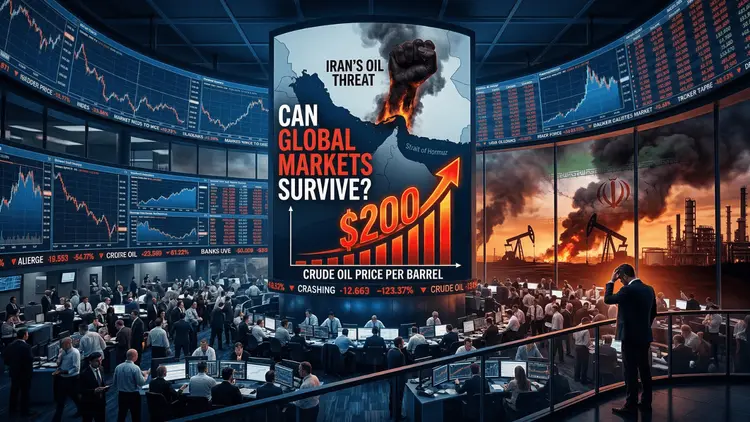
The global economy is officially on notice. As dark plumes of smoke blanket major oil refineries south of Tehran, Iran’s military command has delivered a chilling ultimatum to the West: prepare for crude oil to hit $200 a barrel. This stark warning comes as the blockaded Gulf turns increasingly hostile, with three more merchant ships falling victim to projectiles, bringing the total number of battered vessels to fourteen since hostilities began.
For a brief, heart-stopping moment earlier this week, oil prices flirted with the $120 mark before settling back into a tense $90 holding pattern. The market seems to be placing a massive, perhaps overly optimistic, bet that U.S. President Donald Trump will somehow orchestrate a quick exit from a war he and Israel ignited nearly two weeks ago. For now, multinational energy giants like Exxon Mobil Corp. (NYSE: XOM) and Chevron Corp. (NYSE: CVX) are riding the volatility, while the broader market hopes the worst is already priced in. But the reality on the ground tells a much darker, far more complicated story.
The Strait of Hormuz has effectively transformed from a bustling maritime highway into the world’s most dangerous bottleneck. A staggering one-fifth of the globe's oil supply is currently trapped behind this narrow channel along the Iranian coast, marking the worst energy disruption since the 1970s oil shocks. Ebrahim Zolfaqari, spokesperson for Iran’s military command, made it abundantly clear that the destabilization of regional security lands squarely on the shoulders of the United States. Raising the stakes, Zolfaqari stated Iran would respond with attacks on any bank doing business with the U.S. or Israel, casually advising the public to maintain a 1,000-meter distance from financial institutions.
Despite enduring what the Pentagon describes as the most intense U.S.-Israeli strikes to date, Iran remains heavily armed and openly defiant. The ongoing airstrikes have profoundly reshaped the nation's leadership, reportedly killing Supreme Leader Ayatollah Ali Khamenei and several family members, while leaving his son and successor, Mojtaba, lightly wounded. Yet, state military forces have still managed to launch retaliatory missiles at a U.S. base in northern Iraq, the U.S. naval headquarters in Bahrain, and central Israel. The human toll is mounting rapidly, with Iran citing over 1,300 civilian casualties, alongside military and civilian losses in Israel, Lebanon, and among U.S. armed forces.
While Western governments scramble for a solution, drastic economic measures are being pulled from the playbook. The International Energy Agency is expected to propose a monumental release of 400 million barrels from global strategic reserves. Yet, even this historic flood of crude would take months to implement and merely cover three weeks of normal traffic through the blockaded strait. Meanwhile, Israeli Defence Minister Israel Katz insists the military operation has no expiration date, aiming to completely dismantle Iran's nuclear capabilities and regional force projection.
As the conflict grinds on with zero signs of a diplomatic off-ramp, the world is staring down the barrel of an unprecedented energy crisis. Iran has flatly refused to negotiate or unblock the strait until U.S. and Israeli attacks cease entirely. Until someone blinks, the threat of $200 oil isn't just saber-rattling; it is a looming economic reality.
Source: Information adapted directly from the provided Reuters report: "Iran tells world ‘get ready for $200 a barrel’", Updated: March 11, 2026 at 10:03 AM EDT.