
Bull Trap or Bear Pivot? Making Sense of the Great Gold and Silver Sell-Off
As escalating conflict in the Middle East sends crude oil soaring and freezes Federal Reserve rate cuts, investors must decide if the historic precious metals sell-off is a falling knife or a generational buying opportunity.
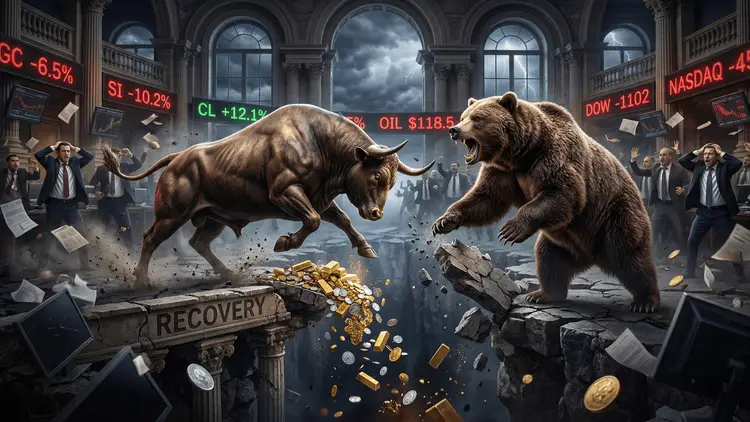
Panic has officially replaced patience in the precious metals market, leaving investors staring at a massive, glaring question: is this a generational dip to buy, or the start of a structural collapse? What was supposed to be a golden stretch for safe-haven assets is quickly tarnishing. As the escalating conflict in the Middle East sends crude oil (NYMEX: CL) prices soaring, the Federal Reserve is being forced to keep its foot firmly on the economic brakes. If you were holding out for imminent interest rate cuts, the market just handed you a stark reality check.
The financial carnage across the metals sector is impossible to ignore. Gold futures (COMEX: GC) sank as much as 6.5%, extending a miserable seven-session losing streak that marks its worst run since 2023. Not to be outdone in the race to the bottom, silver futures (COMEX: SI) plummeted more than 10%. This steep drop is directly tied to the geopolitical chaos unfolding in the Middle East. Roughly three weeks into the intensifying war, global energy hubs are squarely in the crosshairs, and surging energy costs are acting as a direct tax on the global economy.
The Bearish Case: Catching a Falling Knife
For the bears, this current plunge is far from a buying opportunity; it is a fundamental repricing. The core headwind is the Federal Reserve's inflation dilemma. Following attacks on critical Middle Eastern energy facilities, reignited inflationary pressures effectively handcuffed Chairman Jerome Powell. With the Fed holding rates steady and projecting a meager single cut this year, the "higher for longer" interest rate environment has become absolute kryptonite for non-yielding assets like gold and silver.
The fallout is spilling over into broader markets, triggering aggressive sell-offs across global equities and bonds. According to Bart Melek, global head of commodity strategy at TD Securities, the investment banking arm of The Toronto-Dominion Bank (NYSE: TD), investors are legitimately terrified of slower economic growth compounded by tightening central bank policy. This broader market bleed is actively forcing traders to liquidate their precious metals simply to raise desperately needed cash. Furthermore, persistent outflows from gold-backed exchange-traded funds highlight a massive shift in institutional sentiment. As Patrick Armstrong, chief investment officer at Plurimi Wealth LLP, bluntly noted on Bloomberg Television, bullion is currently behaving far less like a reliable harbor and far more like a highly vulnerable speculative asset.
The Bullish Case: Buying the Blood in the Streets
Conversely, the bulls see this massive sell-off as a classic, fear-driven dip waiting to be bought. While the short-term liquidity crunch is undeniably painful, the macroeconomic fundamentals underlying the gold thesis remain completely intact. Bullion is still up almost 6% for the year, proving that despite the recent stall in momentum, a base level of strong demand exists.
The optimistic view relies heavily on historical precedent and the ultimate reality of prolonged inflation. Gold’s current performance is eerily mirroring its decline through the summer of 2022, when Russia’s invasion of Ukraine sent energy markets into a tailspin. During that crisis, the initial shock caused a liquidity sell-off, but gold eventually surged as the reality of persistent inflation set in. Bulls argue that the current oil shock will eventually force the exact same realization. War in the Middle East creates systemic, unavoidable uncertainty. Even if institutions are liquidating gold for cash right now to cover equity losses, systemic fear historically drives capital back into tangible safe havens once the initial panic subsides. If the Fed's high rates push the economy into a sudden recession, central banks will be forced to pivot and slash rates—a scenario that would act as absolute rocket fuel for precious metals.
Ultimately, the decision to buy this dip boils down to your timeline and your faith in the Federal Reserve's ability to navigate an energy-driven inflation spike without crashing the economy. The metal has undeniably lost its immediate safe-haven luster, but for those willing to stomach the volatility, the current discount might just be the entry point of the year.
Source:
- This article is factually based on the March 19, 2026, Bloomberg L.P. report: "Gold and Silver Plunge as Iran War Damps Rate-Cut Hopes" by Jack Ryan and Yvonne Yue Li.