
Breaking China's Grip: US and EU Sign Landmark Critical Minerals Deal
How coordinated price floors and a transatlantic demand signal are being deployed to break Beijing’s grip on the global supply chain.
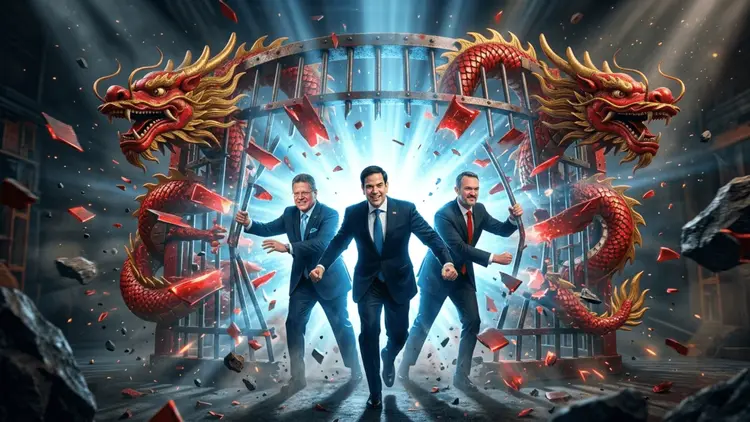
The global scramble for the fundamental building blocks of the 21st century just got a massive Western firewall. For years, Beijing has treated the global rare earth and critical minerals market like its own personal thermostat, cranking up cheap supply to freeze out Western competitors, or suddenly restricting exports to put the squeeze on defense and tech sectors. As of this morning, Washington and Brussels are officially tearing out the wiring and installing their own system.
U.S. Secretary of State Marco Rubio and EU Trade Commissioner Maros Sefcovic signed a landmark Memorandum of Understanding today, formally binding the United States and the European Union into a structured, united front on critical minerals. By combining the world’s two largest consumer bases, the transatlantic allies are organizing their buying power into a massive demand signal designed to break a decades-long reliance on a single, dominant supplier. As Rubio pointed out during the signing, the sheer scale of the U.S. and EU combined customer base makes this an extraordinary counterweight, explicitly calling the current supply concentration an unacceptable risk to national security.
What makes this agreement uniquely aggressive is the actual machinery behind the diplomatic rhetoric. Instead of just throwing grants at early-stage projects and hoping for the best, the action plan introduced by U.S. Trade Representative Jamieson Greer targets the fatal flaw of Western mining: pricing. The rollout explores border-adjusted price floors and coordinated subsidies. Historically, whenever a non-Chinese producer manages to scale up, the market gets conveniently flooded with cheap materials, crashing prices and bankrupting the upstart. A price floor acts as an impenetrable safety net, giving institutional capital the confidence it needs to fund billion-dollar processing facilities without fear of being artificially undercut.
When you establish that kind of structural guarantee, the domestic heavyweights are the immediate beneficiaries. Take MP Materials (NYSE: MP), the crown jewel of American rare earth extraction operating out of California, or Energy Fuels (NYSE: UUUU), a major uranium player that has aggressively pivoted into rare earth element recovery. Both suddenly find themselves operating under a highly hospitable policy umbrella. The same goes for emerging North American processing developers like Rare Element Resources (OTCQB: REXC) and Ucore Rare Metals (TSXV: UCU), whose commercial viability relies heavily on the kind of localized, secure supply chains this MOU demands.
Because the agreement explicitly covers the entire value chain, all the way down to recycling, the ripple effects stretch far beyond pure extraction plays. You cannot just dig your way out of a structural deficit; you have to reclaim the scraps from spent EV batteries and magnets. This coordinated capital environment provides a critical lifeline for battery recyclers like Li-Cycle Holdings (NYSE: LICY) and American Battery Technology Company (NASDAQ: ABAT), helping them compete against cheap virgin materials dumped on the open market.
The broader allied supply network is equally positioned to ride this wave. Australia’s Lynas Rare Earths (ASX: LYC) remains the unquestioned anchor of non-Chinese separated rare earths and stands to gain immensely as Western nations prioritize secure sourcing and localized processing. Meanwhile, exploration developers like American Rare Earths (ASX: ARR) and heavy rare earth hopefuls like Critical Metals Corp (NASDAQ: CRML) finally have a clear, geopolitically backed path to commercialization. Even traditional base metal titans such as Freeport-McMoRan (NYSE: FCX) and lithium giants like Albemarle (NYSE: ALB) benefit from a unified strategy that de-risks capital expansion across the entire energy transition and defense grid.
Ultimately, the free market alone was never going to solve a supply chain crisis engineered by heavy state subsidies abroad. By treating critical minerals as a matter of hard national security and putting tangible price floors on the table, the West is finally signaling that it is willing to pay the premium required for independence. The policy window is officially wide open, and the market is already keeping score.
Sources:
- BNN Bloomberg (April 24, 2026): "EU, U.S. sign critical minerals plan to counter China reliance"
- Anadolu Agency (April 24, 2026): "US, EU sign memorandum on critical minerals to boost supply chain security"
- MINING.COM (April 24, 2026): "US, EU reach critical minerals deal to weaken China's grip"