SPONSORED

A Hot Debate: India's Plans to Double Coal Production

Navigating India's Energy Dilemma: The Complex Path of Coal Production and Climate Responsibility

•• 3 Min
A Hot Debate: India's Plans to Double Coal Production

India is at a critical crossroads as it grapples with the need to address its growing energy demands while facing the pressing climate crisis. Amidst discussions at COP28 in Dubai last December, where climate diplomats debated the urgency of transitioning away from fossil fuels, India stood at a pivotal moment. The Indian government announced its intention to double coal production by 2030, aiming to reach a staggering 1.5 billion tons. Simultaneously, they unveiled plans to add 88 gigawatts of thermal power plants by 2032, with coal playing a predominant role in this expansion.

A Counterintuitive Move

This decision to invest heavily in coal, one of the major contributors to global warming, may seem counterintuitive for a country like India, which is exceptionally vulnerable to the impacts of climate change. However, it is driven by a complex set of circumstances, primarily the need to avoid power shortages as India heads into elections in April and May. India has experienced record-breaking heatwaves and surges in peak electricity demand over the past two years.

The Balancing Act

Prime Minister Narendra Modi's approach seems to be a delicate balancing act, advocating for both renewable energy sources and coal-based power generation. The rationale behind this approach, as explained by Sandeep Pai, director of the climate-focused organization Swaniti Global, is a sharp increase in the demand for electricity.
406034906.jpeg

Challenges in Renewable Energy

Despite India's ambitious goal of achieving 500 gigawatts of clean-energy capacity by 2030, the country faces significant challenges in scaling up its renewable energy infrastructure. BloombergNEF reports that the rate of installation of solar and wind power falls far short of what is required.

Factors Impeding Renewable Energy Growth

Several factors hinder the growth of renewables. Rohit Gadre of BNEF cites misaligned incentives among state-owned electricity retailers, land acquisition difficulties, and inconsistent policies at federal and state levels as primary obstacles. These challenges deter private investors from accelerating renewable energy projects, despite the surging demand for power.

Coal's Uphill Battle

Coal, on the other hand, faces its own set of challenges in attracting new investments. Vibhuti Garg, South Asia director for the Institute for Energy Economics and Financial Analysis, explains that coal power plants take longer to construct and entail higher costs compared to solar and wind power installations.

Realistic Coal Targets

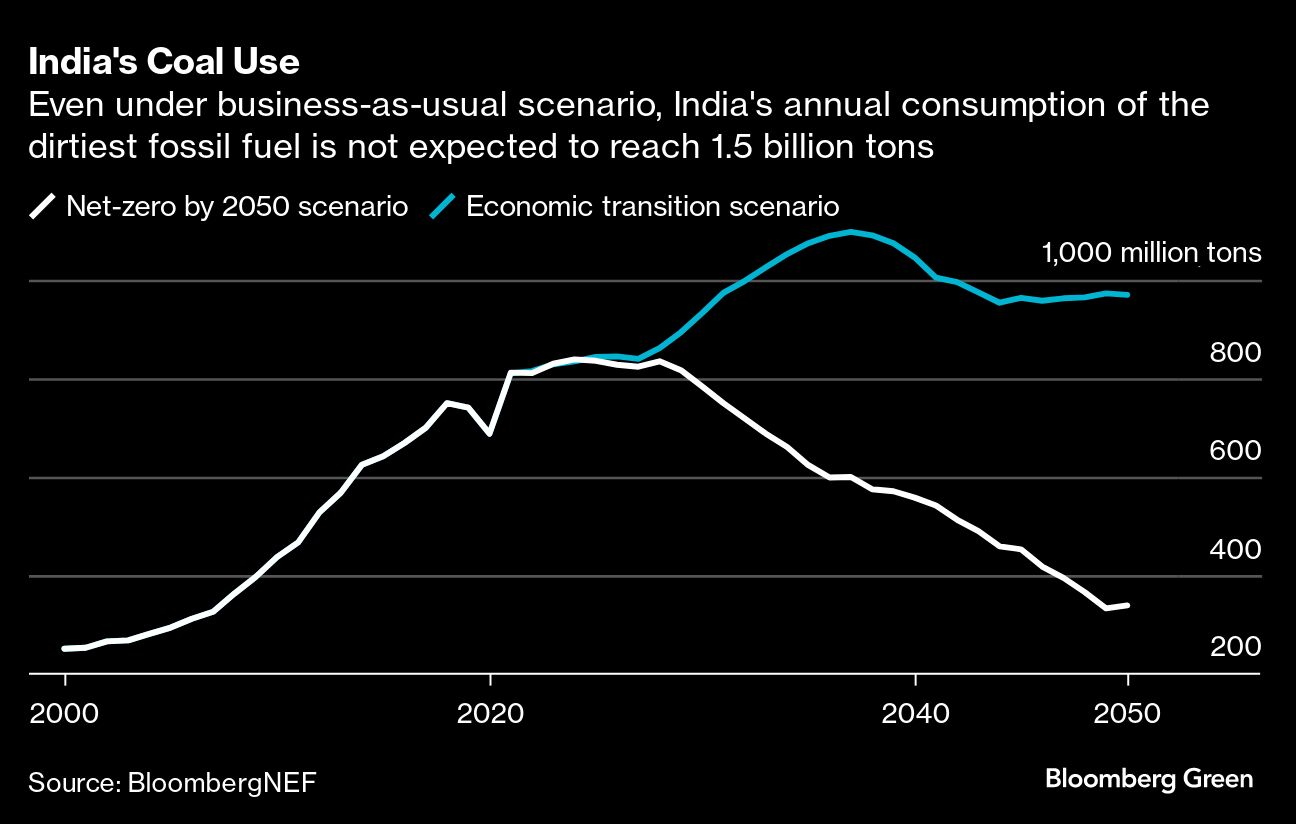
Experts like Pai and Gadre do not foresee India reaching the ambitious coal production targets it has set. BloombergNEF's economic-transition scenario predicts that India's coal consumption will peak at 1.1 billion tons before 2040.
406034468.jpeg

Investment Needs

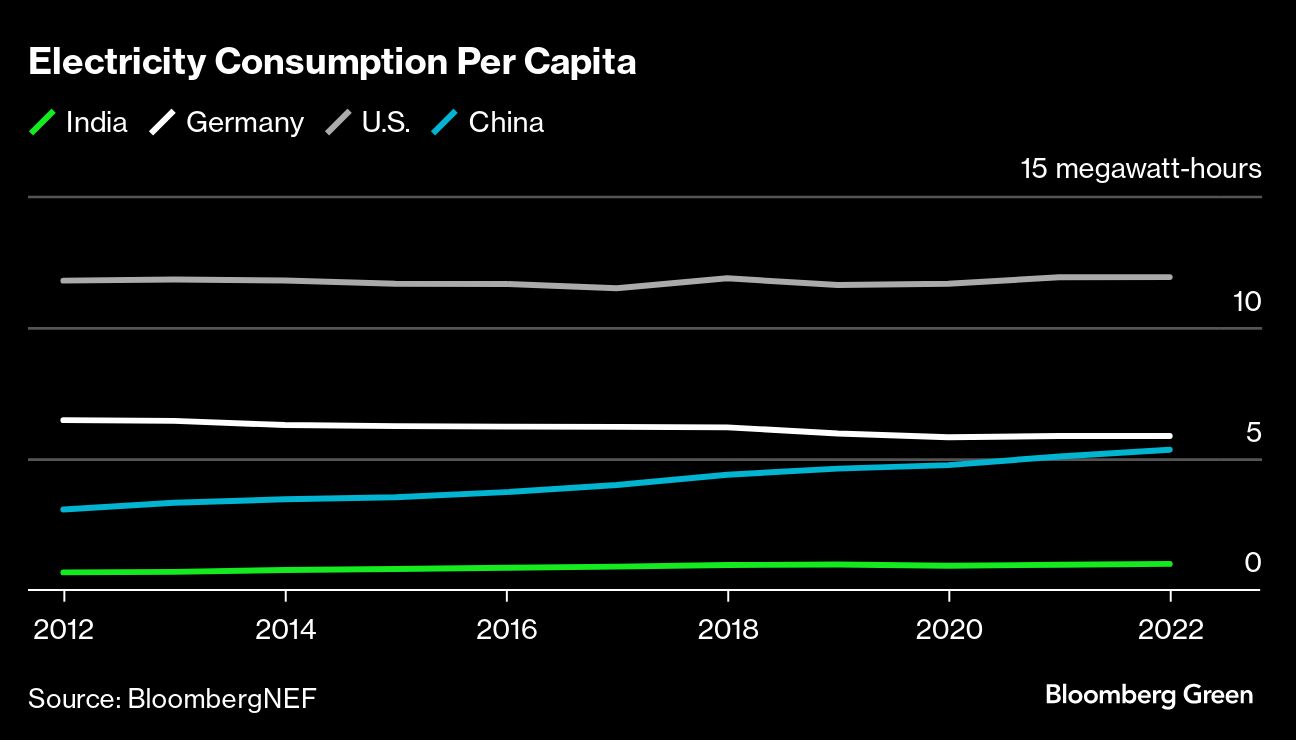
India urgently requires investment in its energy infrastructure as it strives for economic growth. The per capita electricity consumption in India remains significantly lower than that of developed countries and even China. Moreover, India has not yet utilized its fair share of the global carbon budget.

International Cooperation

India, alongside other developing nations, requires more substantial incentives to choose a greener path. While the Group of Seven nations have initiated the Just Energy Transition Partnership in an effort to reduce coal use in countries like South Africa, Vietnam, and Indonesia, these efforts have faced challenges and yielded limited results.

The Call for Global Support

Despite the global consensus on transitioning away from fossil fuels, India's environment minister Bhupendra Yadav emphasized that effective solutions to help countries like India replace coal remain elusive. Rich countries must not only provide financial support but also offer better policies, technology transfer, and skills training.

Conclusion

India stands at a crucial juncture, torn between its soaring energy demands and the pressing need to combat climate change. While doubling coal production appears to be a counterintuitive move, it reflects the intricate challenges and political dynamics of the nation. As the world seeks to transition away from fossil fuels, it is imperative to offer meaningful support and solutions to developing countries like India, ensuring a sustainable and greener future for all.

India

Most Popular News

  1. SpaceX’s $8B Spectrum Deal Sends AT&T, Verizon, and T-Mobile Plummeting
  2. Is Project Vault Securing America’s Supply Chain or Squeezing It to the Breaking Point?
  3. Why Gautam Lohia Shifted from Global Consulting to Reboot a $20M Tech Micro-Cap
  4. Everyday Luxury, Unstoppable Scale: Aritzia Delivers 44% Net Revenue Growth
  5. Can Navy SEAL Leadership and Big Tech Scale Revolutionize Airborne Threat Detection?

Disclaimer


This report should not be viewed as investment advice or as an offer to buy or sell any securities or as an invitation or solicitation of an offer to buy or sell any securities. Neither the author of this report, its publisher, nor any other person associated with the publication of this report, are registered brokers, investment dealers, investment advisers, or financial advisers. The information in this report has not been tailored to the particular needs or circumstances of readers and should not be relied upon as investment advice or recommendations to purchase or sell any of the securities presented in this report. Readers seeking investment advice should contact qualified and registered brokers, investment dealers, investment advisers, or financial advisers prior to making any decision to buy or sell any of the securities referred to in this report. The information in this report should not be construed as investment, legal, or tax advice. No recommendation is made as to whether an investment in the presented securities is suitable for any reader in light of the reader’s particular circumstances.

Readers are cautioned that the publisher of this report covers exclusively securities that carry a high degree of volatility. Investing in such securities is highly speculative and carries a high degree of risk. Investors in such securities could lose all or a substantial portion of their investment. Only those investors who can afford to lose all or a substantial portion of their investment should consider investing in the securities referred to in this report.

This report may include information obtained from publicly available sources, including third-party reports or analysis. Neither the author nor publisher of this report, nor www.juniorstocks.com or its owners, have undertaken any independent investigation into the factual information used in this report, and the information in this report is provided without any warranty of any kind. No representations or warranties are provided regarding the accuracy or completeness of the information provided in this report. Statements of opinion or belief are those of the authors and/or publisher of this report. These statements of opinion or belief are expressions of the author’s and/or publisher’s judgment, and there is no guarantee that those judgments will turn out to be correct. No inference should be drawn that the author and/or publisher have any special or greater knowledge about the presented companies or their securities, or any particular expertise in the industries or markets in which the company operates. Readers should conduct their own due diligence and seek professional advice prior to investing in any securities presented on Juniorstocks.com.

Certain statements in this report constitute “forward-looking” statements. Forward-looking statements often, but not always, are identified by the use of words such as “seek,” “anticipate,” “believe,” “plan,” “estimate,” “expect,” “targeting,” and “intend” and statements that an event or result “may,” “will,” “should,” “could,” or “might” occur or be achieved and other similar expressions. Forward-looking statements express or involve discussions with respect to predictions, expectations, beliefs, plans, projections, objectives, goals, assumptions, or future events or performance; they are not statements of historical facts and should not be viewed as any guarantee of any future result. Forward-looking statements are based on expectations, estimates, and projections at the time the statements are made that involve a number of risks and uncertainties which could cause actual results or events to differ materially from those presently anticipated. The author and/or publisher of this report disclaims any obligation to update the forward-looking statements in this report, whether as a result of new information, future events, or results or otherwise. There is no assurance that forward-looking statements will prove to be accurate, as actual results and future events could differ materially from those anticipated in such statements. Accordingly, readers should not place undue reliance on forward-looking statements.

The information provided in this report is not intended for distribution to, or use by, any person or entity in any jurisdiction or country where such distribution or use would be contrary to applicable law or regulation, or would subject the author or publisher of this report to any registration requirement in such jurisdiction or country.

Information about the editor of this publication:
Juniorstocks.com is a service provided by Piccadilly Capital Group, Office 66, 101 Clapham High Street, London, SW4 7TB, UK. Piccadilly Capital Group is not the publisher of this report and was not paid for the publication of this report. Piccadilly Capital Group seeks to generate web traffic and a growing number of followers through the publication of articles or reports. Directors, officers, and other insiders of the publisher own an interest in Piccadilly Capital Group. Piccadilly Capital Group does not endorse or recommend the business, products, services, or securities of any company mentioned on www.juniorstocks.com. Piccadilly Capital Group will not share your information with any outside third parties. Due to the new data protection basic regulation, we ask you to read our data protection declaration carefully.

Note on copyright:
The contents published on this website and on connected media (e.g., e-mail, X, Facebook) are subject to applicable copyright and ancillary copyright laws. Any use not permitted by applicable copyright and ancillary copyright laws requires the prior written consent of the provider or the respective rights holder. In particular, this applies to the duplication, editing, translation, storage, processing, or reproduction of content in databases or other electronic media and systems. Contents and rights of third parties are marked as such. Unauthorized reproduction or transmission of individual contents or complete pages is not permitted and is punishable by law. Only the production of copies and downloads for personal, private, and non-commercial use is permitted. Links to the provider's website are always welcome and do not require the consent of the provider of the website. Photos and images on the website may not be shared unless the publisher itself has acquired the initial rights from authorized sources. The presentation of this website in external frames is only allowed with written permission. If you notice any violations, please inform us. Please note: The content of our articles, emails, or other publications or social networks such as X, LinkedIn or Facebook is exclusively intended for the designated addressee(s). If you are not the addressee of these articles, emails, or other publications in the market letter or social networks such as Twitter or Facebook or his or her legal representative, please note that any form of publication, reproduction, or distribution of the content of these articles, emails, or other publications in the market letter or social networks such as X, LinkedIn or Facebook is prohibited. Falsifications of the original content of this message during data transmission cannot be excluded in principle.